

The proposed changes for 2027 could affect thousands of self-employed professionals in Hungary. We've put together everything you need to know about the proposed rules, how much you might have to pay, and how you can prepare your business for the year ahead.
This article is based on the draft legislation available as of October 13, 2026. The proposed changes have not yet entered into force, and the final regulations may differ from those described here. This article is for informational purposes only and does not replace personalized advice from an accountant or tax advisor.
KATA, Hungary's simplified tax scheme for small taxpayers, could undergo significant changes in 2027. The government proposal presented on October 6, 2026, would bring back several options that disappeared when the rules were tightened in 2022.
People running a business alongside their regular employment could once again become eligible for KATA, and self-employed professionals might no longer have to automatically turn down business clients.
Let's take a closer look at what's being proposed and what it could mean for your business.
Who Would Be Eligible for the New KATA?
The proposal would reopen KATA to several groups of entrepreneurs who lost their eligibility under the stricter rules introduced in 2022.
- Running a business alongside your regular job? If you have your own clients in addition to your employment, you could become eligible for KATA again.
- Working while retired? According to the proposal, this tax scheme could once again become available to pensioners.
- Studying at university? Students running their own businesses alongside their studies could also become eligible.
- Working with business clients? Under the proposed rules, KATA taxpayers would once again be allowed to invoice companies and other organizations.
The new scheme would still be available exclusively to sole proprietors. This means that business entities such as limited partnerships (Bt.) and limited liability companies (Kft.) would remain ineligible.
What About Disguised Employment?
Allowing KATA taxpayers to invoice companies again raises an important question: how can the government prevent businesses from using KATA to replace regular employment?
Disguised employment occurs when someone is officially working as an independent contractor for a company, but their actual working relationship is more similar to that of an employee.
To prevent this, the proposal includes two important restrictions:
- Invoicing your employer: You would lose your KATA eligibility if you received income from your current employer, your former employer within 24 months of your employment ending, or certain businesses associated with either of them.
- Excessive dependence on a single client: If at least 50% of your annual revenue came from one corporate payer and its associated businesses, your KATA eligibility would end at the close of that year.
The aim of these rules is to ensure that KATA remains a tax scheme for genuinely independent entrepreneurs rather than an alternative to traditional employment.
How Much Would You Have to Pay in 2027?
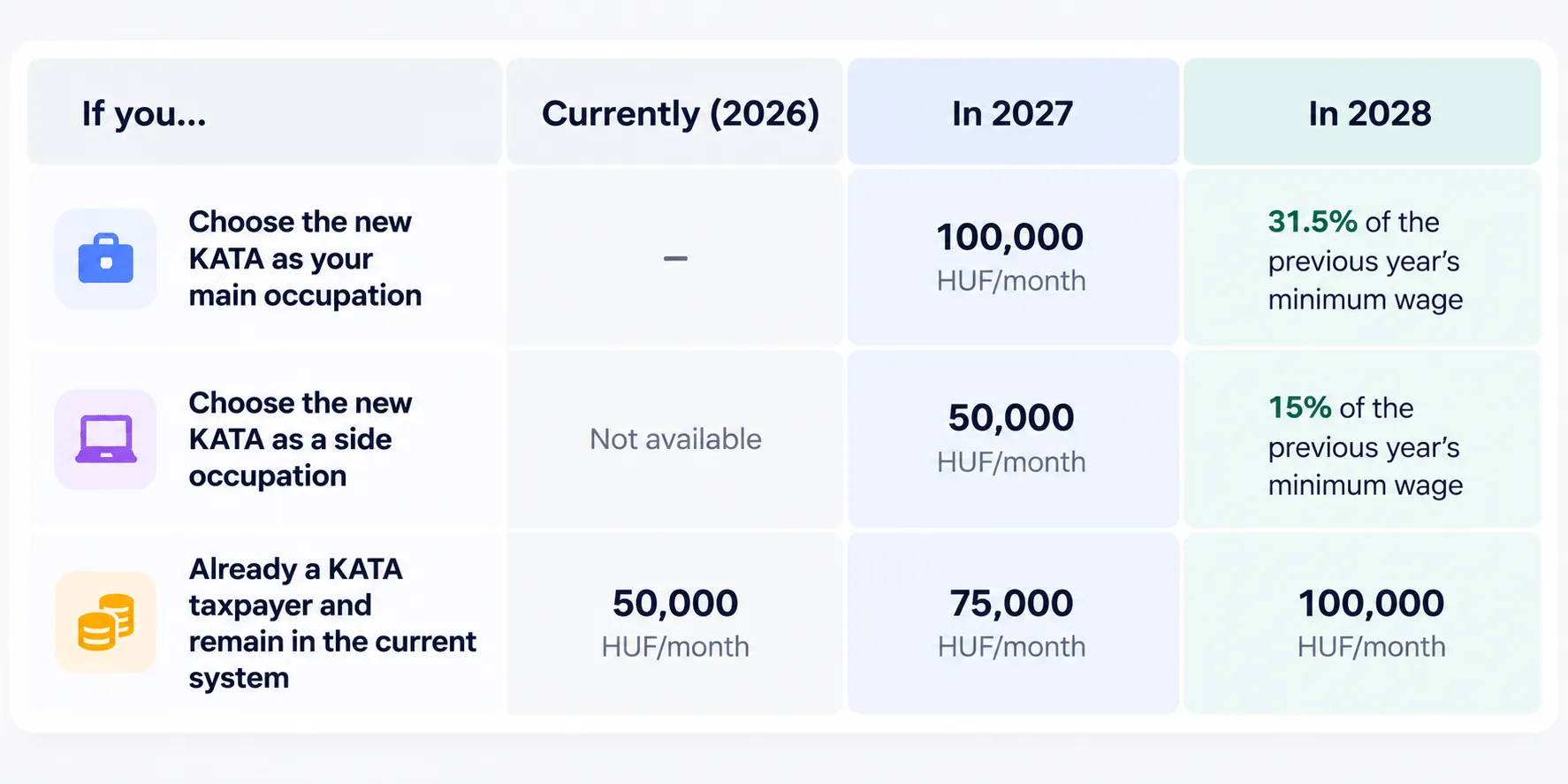
Currently, the monthly KATA tax is HUF 50,000, but this amount could change in 2027.
Under the proposed system, full-time sole proprietors would pay HUF 100,000 per month, while those running a business alongside another occupation would pay HUF 50,000.
To make the changes easier to understand, we've compared the current monthly tax amounts with those proposed for the next two years.
Can You Stay Under the Old KATA Rules If You're Already Using Them?
According to the proposal, yes.
If you're already a KATA taxpayer on December 31, 2026, and you maintain your eligibility without interruption, you could remain under the existing system until the end of 2028. You wouldn't need to submit a separate declaration to do so.
However, that doesn't mean everything would stay the same.
Your monthly tax would increase from HUF 50,000 to HUF 75,000 in 2027, followed by another increase to HUF 100,000 in 2028.
Your annual revenue limit would remain HUF 18 million, and the current restrictions on invoicing companies would continue to apply.
Let's look at an example!
Imagine you're currently a full-time KATA taxpayer working exclusively with individual clients.
If you stayed under the old system in 2027, you would pay HUF 900,000 in fixed taxes over the year.
If you switched to the new KATA, your annual fixed tax would be HUF 1,200,000.
That's a difference of HUF 300,000 per year.
However, the new scheme would offer a higher revenue limit and the opportunity to work with business clients, provided you meet the relevant eligibility requirements.
From January 1, 2029, the old KATA system would be discontinued. Entrepreneurs who remained under it would automatically move to the new system unless they declared otherwise in advance.
When making your decision, it's worth considering more than just the monthly tax amount. Your revenue, client base, and social security benefits should all play a role.
An accountant can help you calculate which option would work best for your situation.
You Could Invoice Companies Again. But How Much Would It Cost?
One of the most interesting proposed changes for entrepreneurs is the return of business-to-business invoicing.
However, this would come with additional tax rules.
Under the new KATA, business revenue would be subject to a supplementary tax calculated at 15%, with the annual fixed KATA payments credited against this amount.
In other words, invoicing companies wouldn't necessarily mean paying additional tax. You would only owe supplementary tax if 15% of your business revenue exceeded the amount of fixed KATA tax eligible for deduction.
Let's see how this would work in practice!
Imagine you're a full-time KATA taxpayer in 2027, and:
- You earn HUF 9 million from individual clients.
- You invoice business clients for HUF 5 million.
- Your total annual revenue is HUF 14 million.
15% of your business revenue would be HUF 750,000.
Since your annual fixed KATA payments would total HUF 1,200,000, they would fully cover the calculated supplementary tax.
In this example, you wouldn't have to pay any additional KATA tax.
But what if you earned HUF 12 million from business clients instead?
15% of that amount would be HUF 1.8 million.
After deducting the HUF 1.2 million annual fixed KATA tax, you would owe an additional HUF 600,000.
These calculations assume continuous KATA taxation throughout the entire year and are intended solely to illustrate how the supplementary tax would work. You would still need to meet the separate eligibility requirements for invoicing business clients.
Minup Tip: Make Invoicing Easier Before the Changes Arrive
If you work with both individual and business clients, keeping your invoices organized and easy to find is especially important.
Searching through months of invoices and emails at the end of the year is about as enjoyable as starting your Christmas shopping on December 23.
You can connect Minup with Számlázz.hu or Billingo, making it easier to manage invoices related to your bookings without constantly switching between different systems.
That means less time spent on administration, while your issued invoices remain easy to find in your invoicing software.
The Annual Revenue Limit Could Increase to HUF 22 Million
Under the proposal, the annual revenue limit for the new KATA would increase from HUF 18 million to HUF 22 million.
That's an additional HUF 4 million in annual revenue, equivalent to approximately HUF 333,000 more per month on average.
Revenue exceeding the limit would still be subject to an additional 40% tax.
The higher limit could be particularly valuable for entrepreneurs whose businesses have grown in recent years or who are planning to introduce new services, attract more clients, or expand their capacity in 2027.
However, there's an important distinction to keep in mind.
The HUF 22 million limit would apply to the new KATA scheme. Entrepreneurs who temporarily remain under the old system would still have an annual revenue limit of HUF 18 million.
It's also important not to confuse the KATA revenue limit with the threshold for VAT exemption, as these are governed by separate regulations.
Minup Tip: If Your Business Is Growing, Your Calendar Needs to Keep Up
A higher revenue limit could be a great opportunity to think about how you can increase your business income.
And that doesn't necessarily mean you need to find more new clients. Building stronger relationships with your existing customers can be just as valuable.
If you offer services that clients book regularly, consider introducing multi-session passes or service packages.
With Minup's pass management feature, your clients can easily book their upcoming appointments, while you can keep track of their remaining sessions.
A well-designed package can encourage clients to return more consistently and help make your revenue more predictable.
Social Security Benefits Could Change Too
The proposed reform would also increase the benefit calculation base for full-time KATA taxpayers.
But what exactly is the benefit calculation base, and why does it matter?
It's the amount the government uses as the basis for calculating certain social security benefits, such as sick pay, maternity benefits (CSED), childcare benefits (GYED), and future pension entitlements.
It doesn't represent your actual revenue or an amount you automatically receive.
Instead, it's a calculation base that can influence how much you're entitled to receive through these benefits.
Under the proposal, the monthly benefit calculation base for the new KATA would be HUF 317,000 in 2027 and would be linked to the minimum wage from 2028 onwards.
A lower calculation base would apply to entrepreneurs who temporarily remain under the old system.
That's why, when comparing the old and new KATA schemes, it's worth looking beyond the monthly tax payments.
You should also consider which social security benefits you may qualify for and how much those benefits could be worth.
What Can You Do to Prepare?
Although the final rules are still pending, there are a few things you can do now to make the next business year easier.
1. Review Where Your Revenue Comes From
How much of your income comes from individual clients, and how much comes from businesses?
With the proposed differences in taxation, understanding your revenue sources could become particularly important when planning your finances for 2027.
2. Consider Whether You Want to Work With Business Clients
If the proposal is approved, the return of business invoicing could create new opportunities for your business.
It's worth thinking about whether you could offer your existing services to companies as well.
For example, this could include office massage services, corporate event planning, employee training sessions, or business consulting.
3. Simplify Your Administration
If you're still arranging appointments through messages, managing your calendar manually, and creating every invoice individually, it might be time to consider which tasks you could automate.
With Minup's online booking page, your clients can book appointments themselves.
Booking confirmations and reminders can be sent automatically, while integrated payment and invoicing solutions can take even more administrative work off your plate.
4. Review Your Options With Your Accountant
According to the proposal, registration for the new KATA would open on December 1, 2026, with the new system taking effect on January 1, 2027.
Before making any decisions, however, it's worth comparing the available tax schemes based on your own revenue, expenses, and business plans.
You'll also need to check the final deadlines and eligibility requirements once the legislation is confirmed.
A Lot Could Change in 2027. But You Can Start Improving Your Business Today.
The proposed KATA reform could bring new opportunities for many self-employed professionals in Hungary.
However, the details may still change, so it's important to wait for the final regulations before deciding to switch tax schemes.
In the meantime, there's plenty you can do to make your everyday business operations easier.
If you're tired of endless back-and-forth messages about appointments, manually updating calendars, and spending too much time managing bookings, Minup can help simplify the way you run your business.
Your clients can book appointments and pay online, while the right integrations can help automate your invoicing.
That leaves you with more time to focus on your business and the people who matter most: your clients.
The new KATA may have to wait. Less admin doesn't.
Sources
- Government of Hungary – Draft Legislation on the Itemized Tax for Small Taxpayers
- KATA 2027 – Detailed Overview of the Draft Legislation
- Minup – Online Payments and Automated Invoicing
Did you like the article? Want to read more?
sign up to receive an email when we write a similar article!